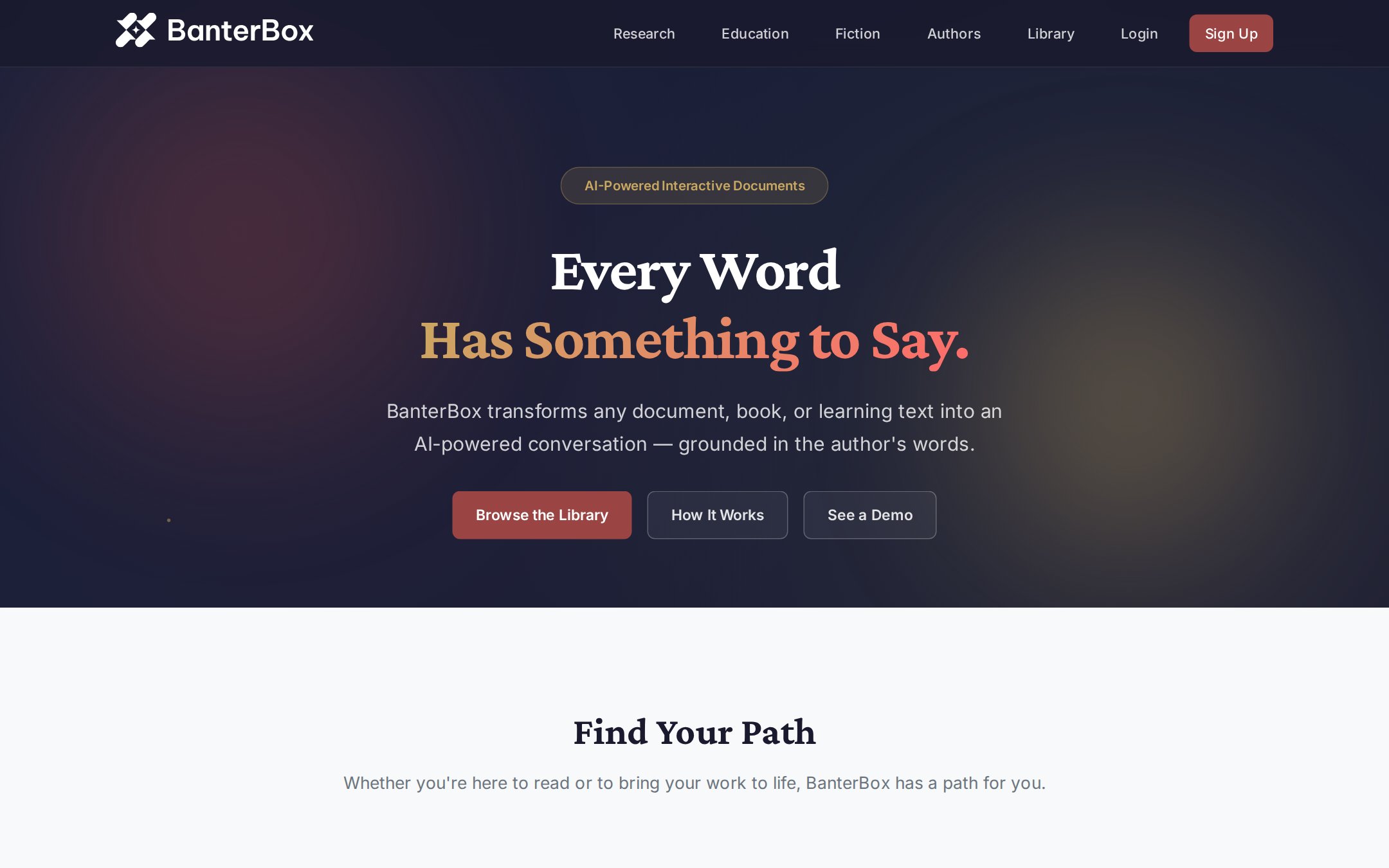
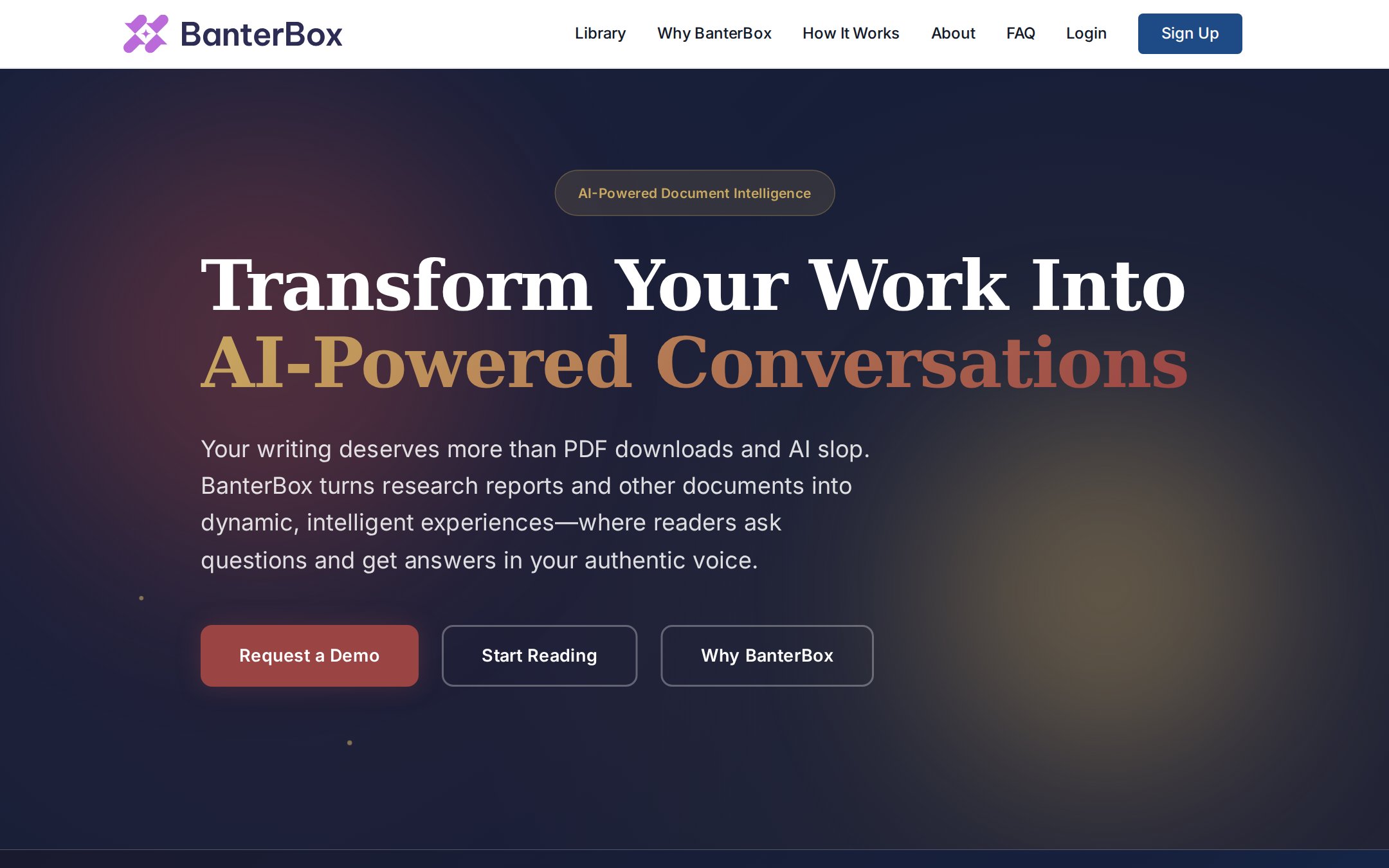
BanterBox lets readers ask a document questions, interview its author, or talk to a story's characters — every answer grounded in the source text with tap-to-verify citations. It spans three reading experiences — research & policy, education, and fiction — and gives content owners an on-brand, analytics-rich conversational layer over their own material.
Long-form work — strategy reports, policy briefs, textbooks, novels — increasingly gets skimmed or pasted into general chatbots, where answers are ungrounded, uncited, and disconnected from the author's intent. Publishers and institutions lose control of how their work is read, and get no insight into engagement. BanterBox was built so content owners can offer their own audience an on-brand, source-cited conversational layer — and finally see how readers actually engage.
We built a Python/Flask platform around a tiered retrieval engine — vector embeddings, BM25 keyword search, and a cross-encoder reranker — that routes questions through a multi-provider LLM layer (Claude Sonnet as the default, with OpenAI, Google, and Perplexity fallbacks) and returns every answer with tap-to-verify citations back to the source passage. An ingestion pipeline turns uploaded PDFs into a navigable 'argument tree,' and supporting services add text-to-speech narration, real-time translation, and a content-repurposing studio. The reading experiences ship as React/TypeScript apps over server-rendered portal pages, deployed on Render with Postgres, Redis, Celery, and AWS S3 + CloudFront, behind Auth0 and white-label client domains.
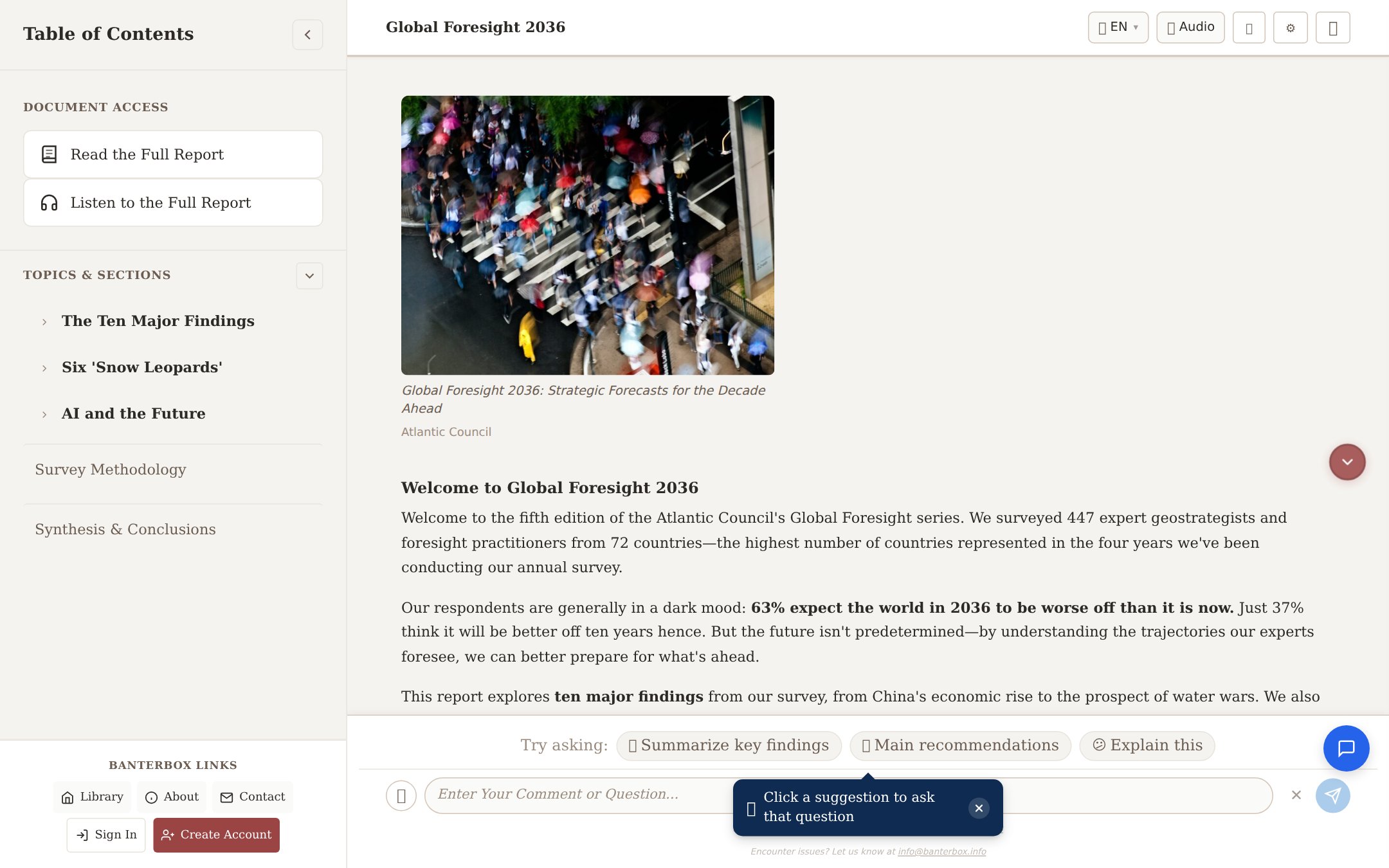
Cited Q&A over any document
A tiered RAG engine — embeddings + keyword search + cross-encoder reranking — answers reader questions and links every claim back to the exact source passage.
Argument-tree navigation
Uploaded PDFs are decomposed into structured, navigable nodes: section-by-section guided reading with 'go deeper' drill-downs and shareable deep links.
Interview the author
Answers can be delivered in the document author's own voice and persona, not a generic chatbot tone.
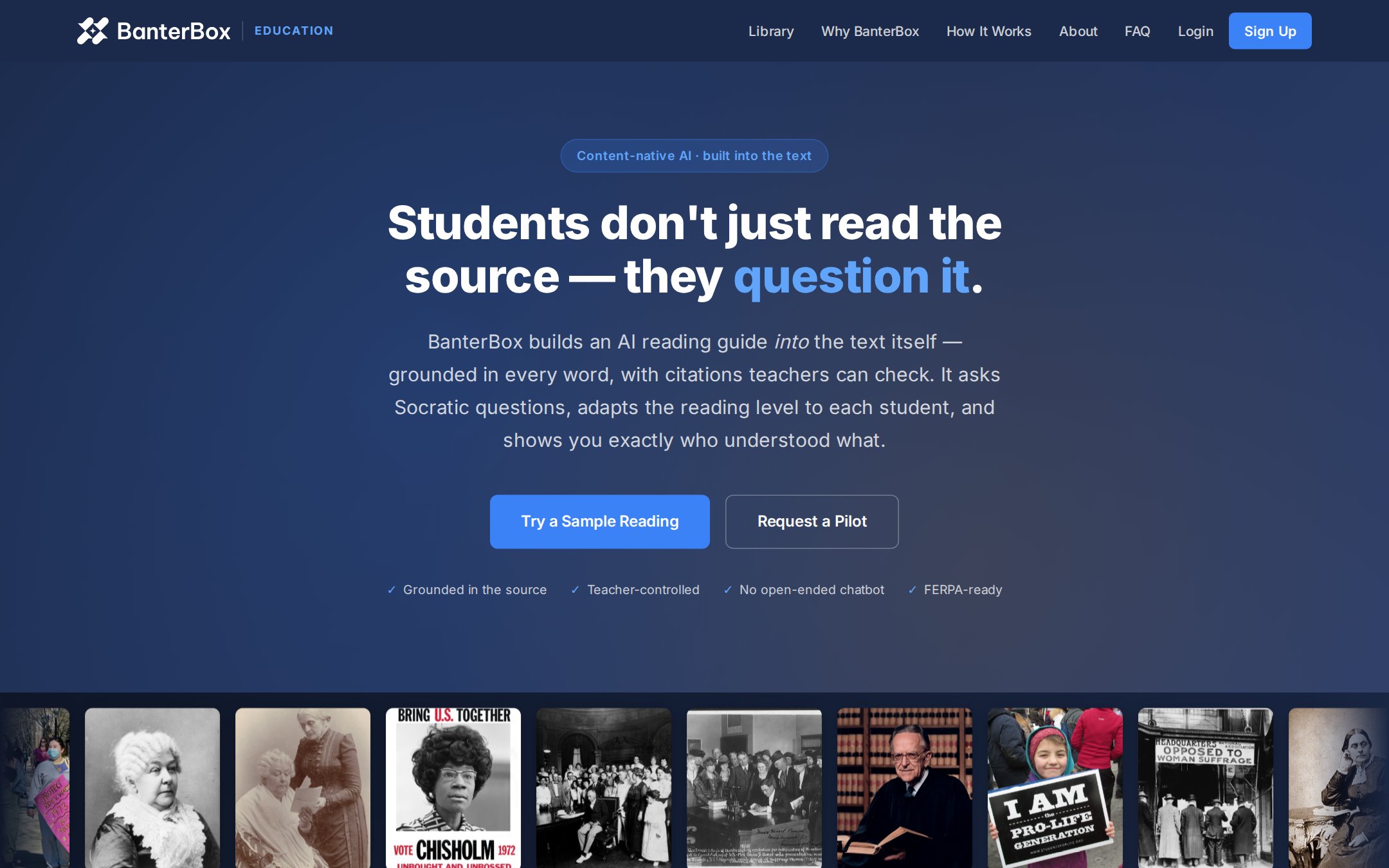
Education mode
Adaptive reading levels, Socratic questioning, red/yellow/green comprehension feedback, and a teacher dashboard with live class analytics.
Interactive fiction
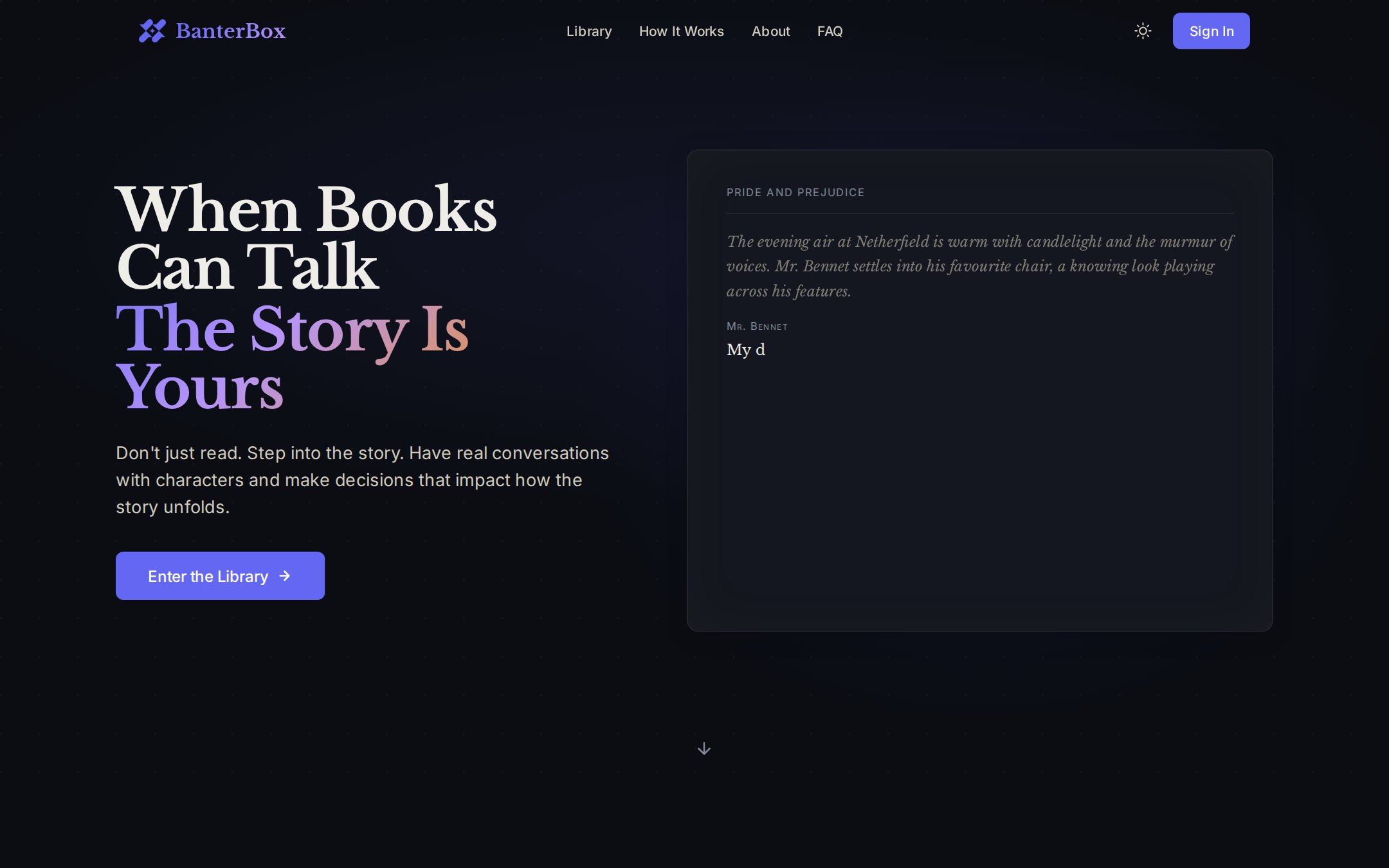
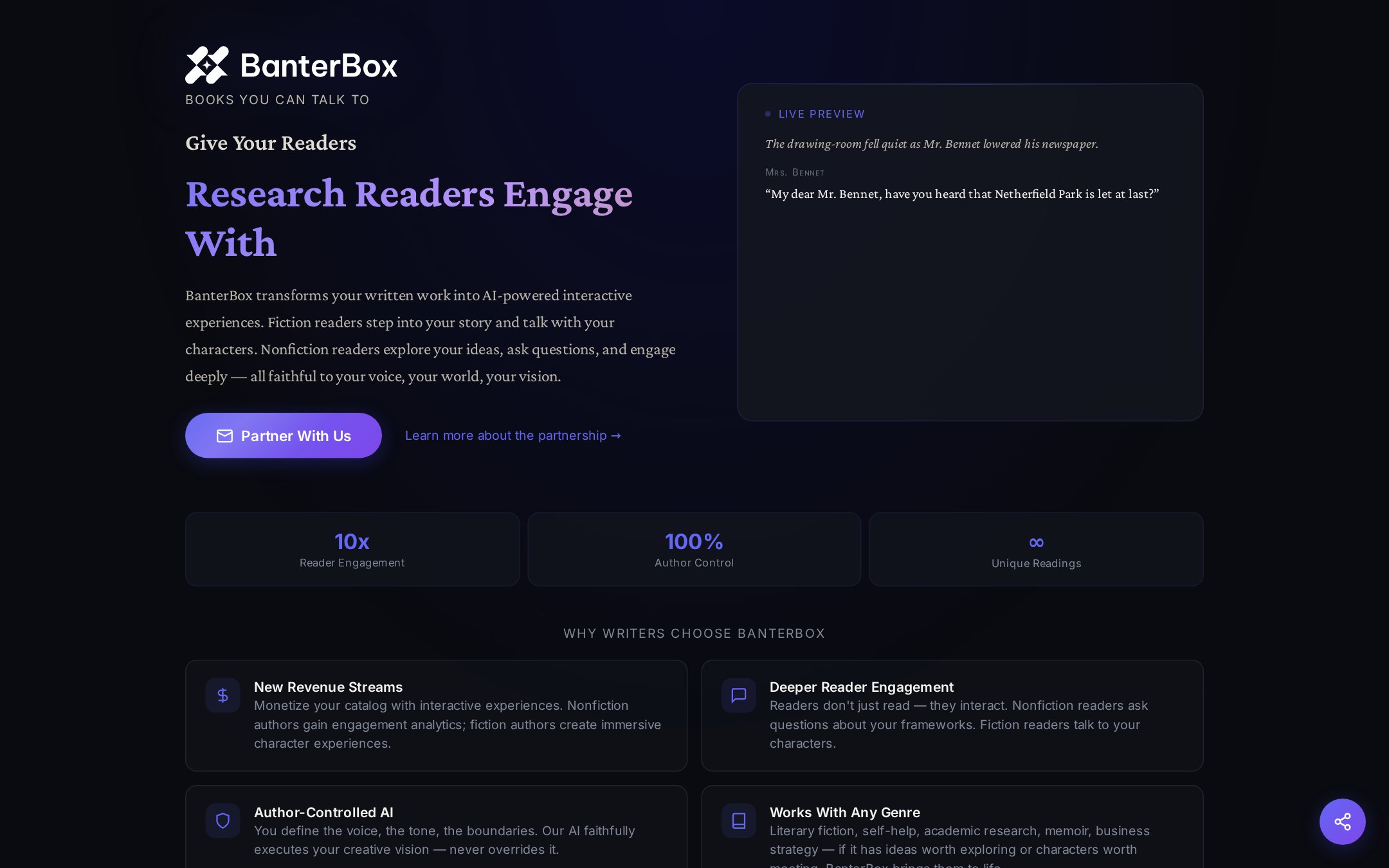
Readers talk to characters, 'ask the book,' and move through a branching narrative engine where choices carry felt consequences.
Multilingual + audio
Real-time translation and text-to-speech narration — the live policy pilot fielded spontaneous reader questions in English, Russian, and French.
Publisher dashboard & white-label
Per-document and reader-engagement analytics, custom domains, gated access, and on-brand theming for each client.
Content-repurposing studio
Turns a single document or transcript into quote cards, blog posts, emails, briefings, and social posts.
- React + TypeScript
- Vite
- Tailwind / MUI
- TanStack Query
- Jinja2
- Python 3.12
- Flask 3
- PostgreSQL
- Redis
- Celery
- Claude (Anthropic)
- OpenAI · Google · Perplexity
- RAG + BM25 + reranker
- Embeddings · TTS · translation
- Render
- AWS S3 + CloudFront
- Auth0
- Sentry